Some LMD projects are not about printing a simple wall, bead or coating. They are about proving that a difficult geometry can be planned, built, monitored and turned into a physical demonstrator without exposing confidential process data.
The short answer
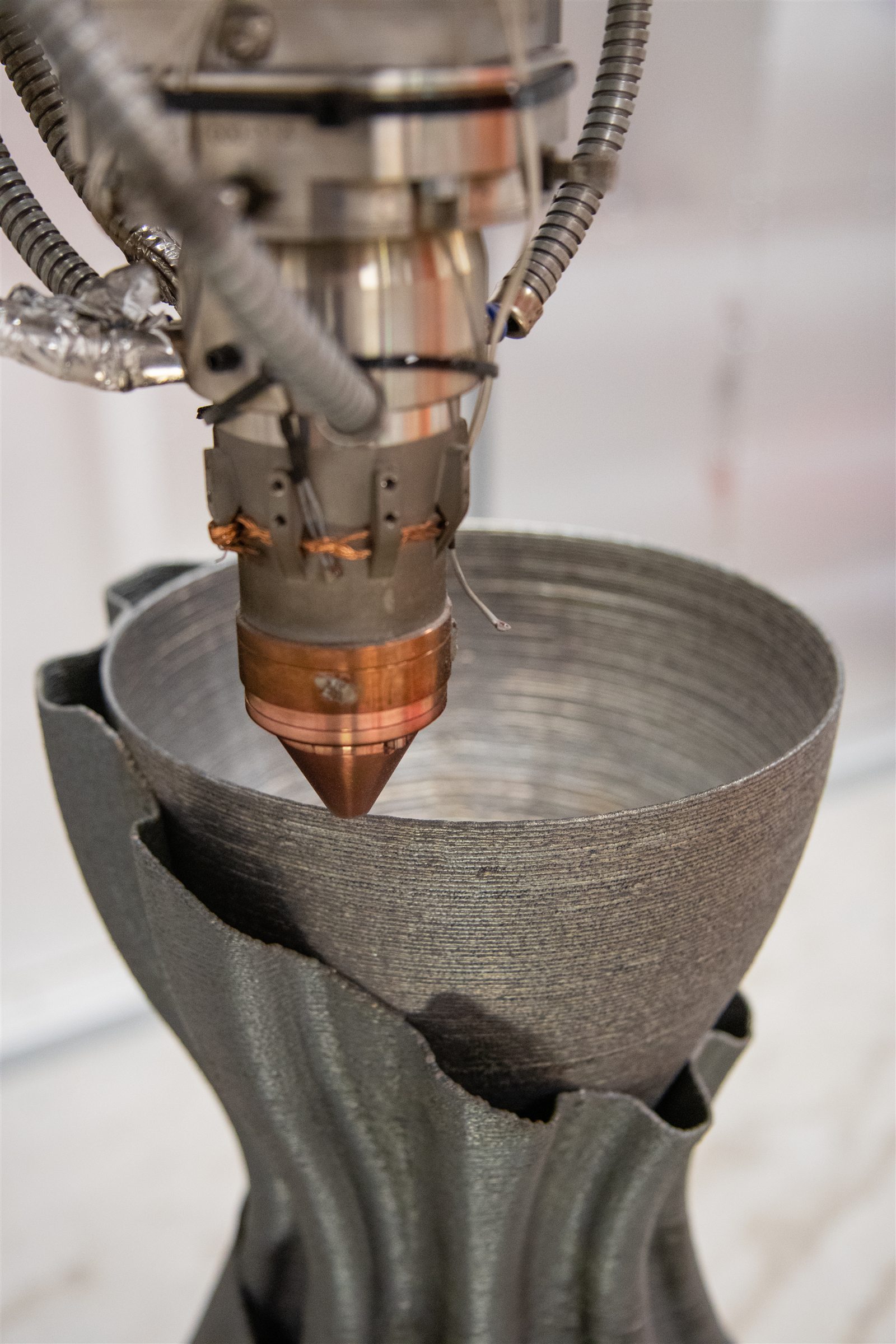
Exafuse demonstrated multi-material Laser Metal Deposition on a large, thin-walled process-equipment geometry. The demonstrator was approximately 750 mm tall, used two high-performance Ni-based alloys, included a wall thickness of about 1.8 mm and required more than 1,070 layers over roughly 50 hours of printing.
Why this build is interesting
Large thin-wall LMD is difficult because the process has to keep wall height, wall width, thermal input, powder efficiency, start/stop behavior and toolpath strategy stable over many layers. This was not a blocky sample. The public capability story is a rocket-nozzle-inspired, water-cooled process-equipment demonstrator with inner and outer structures and connecting rib-like features.
Multi-material purpose
The demonstrator used two Ni-based alloys for different functional reasons: Inconel 625 for corrosion resistance and high-temperature durability in the inner structure, and Inconel 718 for strength and oxidation resistance in the outer structure and rib-like features. The broader point is material zoning: LMD can help place different material behavior in different regions of one build when compatibility, transition behavior and inspection are reviewed.
Evidence in the numbers
| Public capability point | Context |
|---|---|
| Approx. 750 mm height | Large demonstrator scale, not a small coupon. |
| Approx. 1.8 mm wall thickness | Thin-wall LMD stability was part of the development challenge. |
| Two Ni-based alloys | Material zoning between inner and outer functional regions. |
| More than 1,070 layers | Long build planning and layer consistency mattered. |
| Roughly 50 hours of printing | The route required sustained process planning, not a short bead trial. |
Readable summary: the proof is strongest as a process-development and demonstrator story; it is not a blanket qualification for every nozzle, heat exchanger or multi-material production part.
What had to be solved
- Thin walls needed stable layer growth over a long build.
- Local heat flow changed as the geometry evolved.
- Material transitions had to be planned at capability level.
- Powder delivery and deposition behavior had to remain useful across different regions.
- The final demonstrator needed documentation, video and physical review, not only a finished object.
What this proves and what it does not prove
This proof shows that Exafuse can translate a complex, thin-wall, multi-material LMD concept into a physical demonstrator and documented build route. It does not prove pressure qualification, universal media compatibility, production repeatability for every geometry or final customer release without application-specific validation.
What to send for a similar review
- Target geometry, CAD or concept sketch.
- Approximate size, wall thickness and critical zones.
- Desired material zones and why each zone needs a different function.
- Expected operating environment, cooling, corrosion, heat or strength requirements.
- Whether the goal is a demonstrator, prototype, repair or production route.
- Inspection, test, video, documentation and confidentiality expectations.
Recommended next steps
Use the metal AM service page, LMD process guide, LMD vs SLM comparison, alloy-selection article, monitoring article and manufacturing review route when planning a complex LMD demonstrator.