
Copper and copper-alloy parts are difficult candidates for laser-based deposition. They reflect laser energy, conduct heat away quickly and can distort if the process puts too much heat into the substrate. That makes rotor-wedge coating a useful public capability story: the challenge is not simply adding metal, but adding it with a controlled thermal route.
The short answer
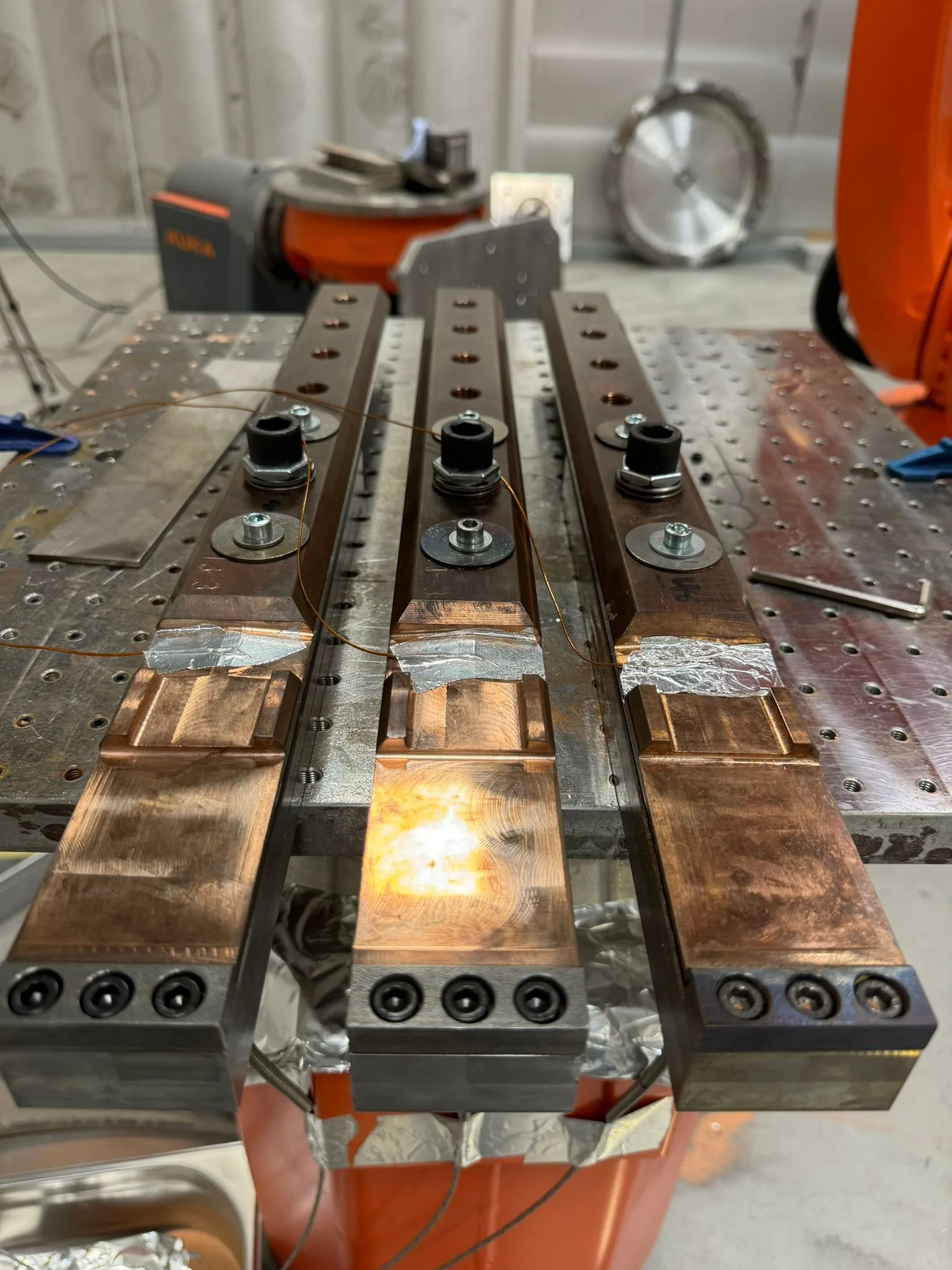
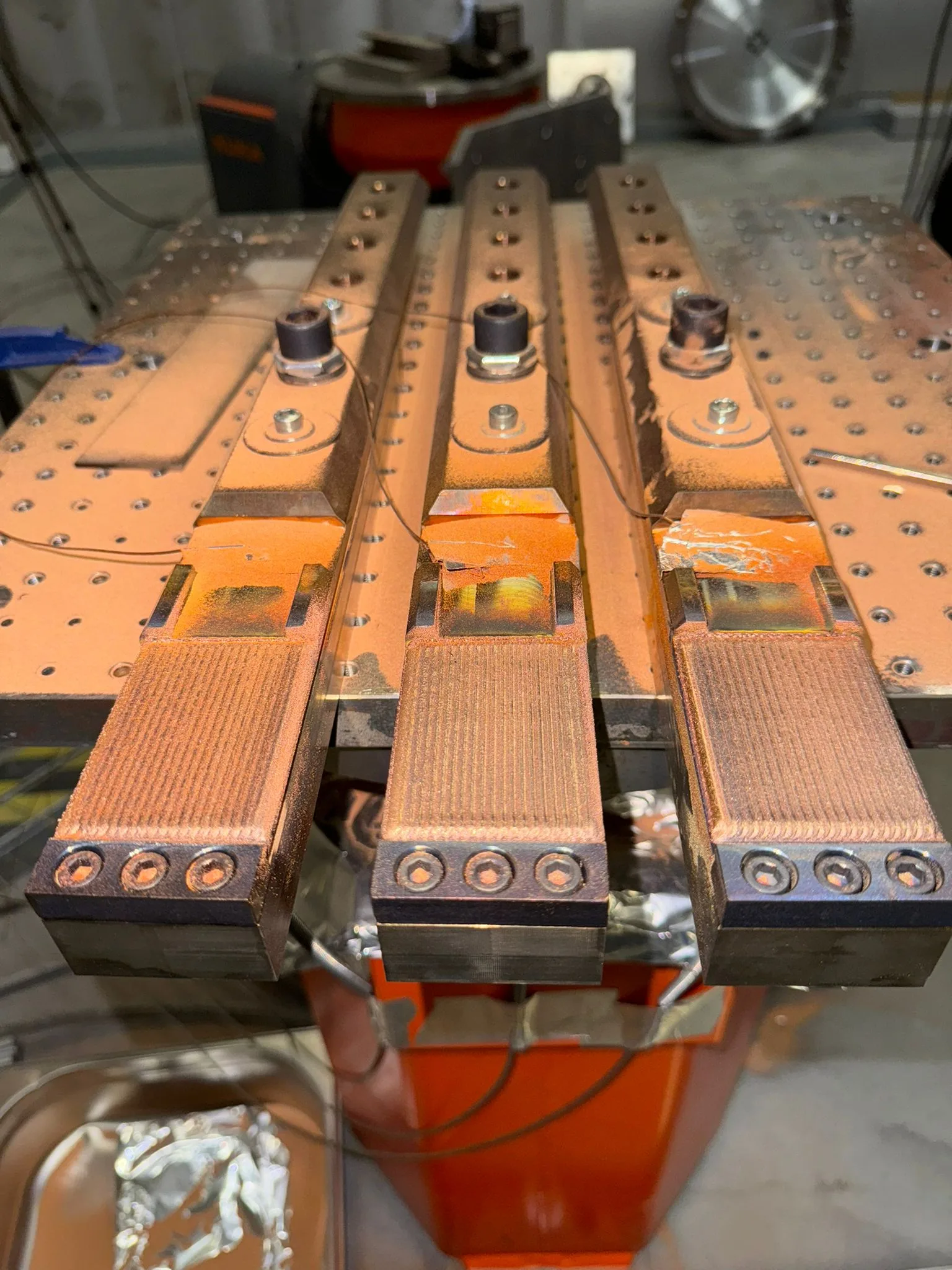
Exafuse developed a Laser Metal Deposition route for copper-alloy coating on turbo-generator rotor-wedge components. The public lesson is heat-managed LMD: fixture setup, temperature monitoring, controlled deposition and before/after evidence without publishing the process recipe.
Before coating
After coating
Why copper coating is difficult
- High reflectivity makes laser energy coupling harder.
- High thermal conductivity pulls heat away from the melt pool.
- Too little energy can create poor bonding or unstable tracks.
- Too much heat can create distortion or substrate risk.
- Repeated seams can raise component temperature over time.
- Fixture contact, cooling and pause strategy can change the result.
What had to be controlled
The route was treated as a thermal-management problem as much as a deposition problem. The publication-ready controls are temperature observation, thermocouple-supported monitoring, controlled deposition timing, fixture planning and comparison between single-part and multi-part coating logic. Exact temperature limits, laser settings, powder-feed values and path strategy remain project-controlled.
Why multi-part coating can help
For a batch of similar copper components, the process does not always need to wait idly for one part to cool. A multi-part route can move between similar components while temperature is managed. That matters because feasibility should consider not only whether a coating can be deposited, but whether the route can become practical for repeated parts.
Decision table
| Decision point | What it means for copper-alloy LMD coating |
|---|---|
| Substrate heat flow | Copper conducts heat quickly, so the route needs controlled energy input and monitoring. |
| Coating purpose | Define whether the goal is local build-up, dimensional restoration, wear/corrosion behavior or thermal/electrical function. |
| Fixture strategy | How the part is held can affect heat flow, access, distortion and repeatability. |
| Batch logic | Similar parts may allow a process sequence that balances productivity and cooling time. |
| Validation | Final release still depends on adhesion, geometry, coating condition, finishing and agreed inspection. |
Readable summary: evaluate copper-alloy LMD coating when local functional build-up is valuable and the project can define substrate, coating purpose, thermal boundary, fixture constraints and inspection needs; escalate when exact qualification criteria, distortion limits or final performance requirements are unclear.
What this proves and what it does not prove
This proof shows a practical Exafuse route for copper-alloy LMD coating on rotor-wedge components with visible before/after media and process video. It does not prove universal copper-component feasibility, automatic coating qualification, guaranteed wear/corrosion performance or a transferable parameter recipe.
What to send for a similar review
- Part photos or drawings of the coating area.
- Base material and target coating material or material family.
- Part size, access limits and fixture constraints.
- Coating thickness or build-up requirement.
- Known temperature, distortion or dimensional limits.
- Operating environment and functional target.
- Inspection, cross-section, adhesion, surface or qualification expectations.
- Whether photos or video may be used publicly.
Recommended next steps
Use the laser cladding service page, copper-substrate cladding article, corrosion and high-temperature coating guide, qualification and documentation guide, material selector and cladding review route when planning copper-alloy coating on thermally sensitive components.