
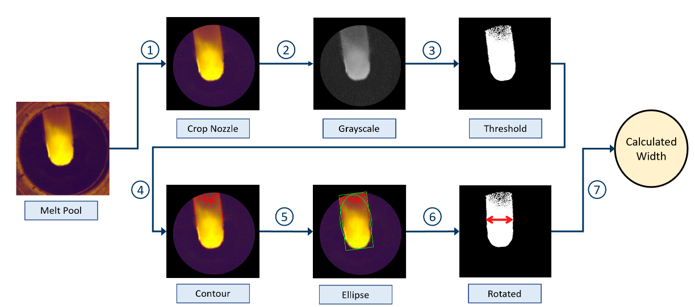
Many monitoring discussions stop at the camera. That is not enough. A useful LMD monitoring pipeline has to connect signal capture, data labeling, process context, review logic and physical validation.
The short answer
The monitoring pipeline matters because process images become useful only when they can be tied to part geometry, machine state, layer position, material context and later inspection outcomes. Without that chain, the data remains interesting but weak for industrial decisions.
A practical pipeline structure
A publication-ready LMD monitoring pipeline usually includes:
- signal capture from melt-pool or process-view cameras;
- timestamps and synchronization with machine events;
- geometry or path context such as position, layer and segment;
- material and substrate context;
- review labels or anomaly notes from engineers;
- downstream inspection results used as ground truth.
Why metadata matters
The same image can mean different things depending on whether the process is entering a corner, building on a heat-accumulated zone, switching orientation or running on a different substrate condition. Metadata turns a picture into an engineering signal.
Decision support comes before automation
For most industrial teams, the first value is earlier review and better prioritization. The pipeline should help answer questions such as: which zones need re-checking, where did conditions drift, and which builds should be compared before the next parameter decision?
Validation closes the loop
Even a strong monitoring pipeline still needs physical confirmation. Cross-sections, microscopy, dimensional checks, surface inspection and documented release criteria turn process data into something trustworthy.
What buyers should define early
If monitoring data needs to be part of the project documentation, define that before quotation. The supplier then has to plan what is recorded, how it is stored, how it is reviewed and what it is supposed to prove.
Related pages
Read this together with A12: Monitoring and control in DED / LMD, A35: Melt-pool monitoring, A36: AI in process control and A42: validating AI outputs.