
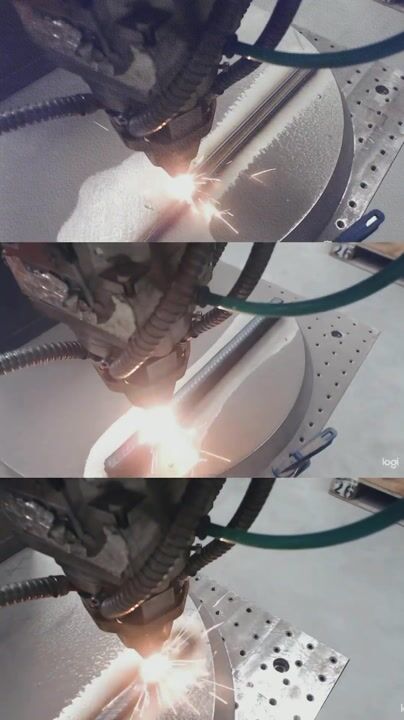
New metal powders are not proven by chemistry alone. A powder can look strong on a datasheet and still behave poorly in a laser process. Flowability, melt-pool stability, oxidation behavior, cracking sensitivity, dilution, build height and surface quality all have to be tested under real deposition conditions.
The short answer
Exafuse can use LMD test walls as a practical screening step for new or modified metal powders. The goal is not to produce a final part. The goal is to create controlled deposited material that can be compared, sectioned, measured and tested.
Public video context
The video shows LMD wall building from metal powder candidates in a public powder-development context connected to Outokumpu. The article focuses on capability and does not publish exact powder names, alloy recipes, parameter windows, customer requirements or test results.
Why test walls are useful
An LMD wall is a compact test geometry. It is simple enough to build quickly, but useful enough to reveal process behavior before a team commits to a complex component trial.
- Does the powder feed consistently?
- Is the melt pool stable enough for the next development step?
- Does the track build with predictable height and width?
- Is the deposited wall continuous enough for later samples?
- Are there visible signs of cracking, overheating, oxidation or poor wetting?
- Is there enough material to cut, polish and test?
What wall builds can support later
The exact test plan depends on the powder and target application, but LMD wall builds can create deposited material for hardness testing, metallographic cross sections, SEM/EDX analysis, porosity review, dilution review, machining trials, batch comparison and parameter refinement.
What a powder developer can evaluate
For a material team, the wall is a bridge between powder production and full application trials. It shows processability before a complex part is built, creates comparable deposits and supports faster learning cycles when a powder does not feed well, cracks easily or produces unstable geometry.
Why LMD fits this screening role
LMD adds material locally from powder, so different powders can be screened without designing a final component. The process can expose powder feeding, melting, layering and wall-building behavior in a way that is directly relevant to later coating, repair, cladding or additive manufacturing trials.
What not to overread
A successful test wall does not automatically qualify a powder for every part. Before production use, the team still needs to consider target application, substrate compatibility, mechanical requirements, corrosion or wear requirements, post-processing, repeatability across batches, inspection and whether wall behavior transfers to the final geometry.
What to send for a similar powder trial
- Powder type or material family.
- Target application or reason for the powder development.
- Available powder quantity and basic powder data if available.
- Intended substrate material.
- Target tests after deposition, such as hardness, microscopy, corrosion or wear screening.
- Whether the output should be a wall, bead-on-plate sample, coating coupon or geometry-specific trial.
- Confidentiality limits for photos, video and partner names.
Recommended next steps
Use the metal AM service page, materials overview, LMD process guide, alloy-selection article, melt-pool monitoring article and contact route when planning a powder-development screening route.