
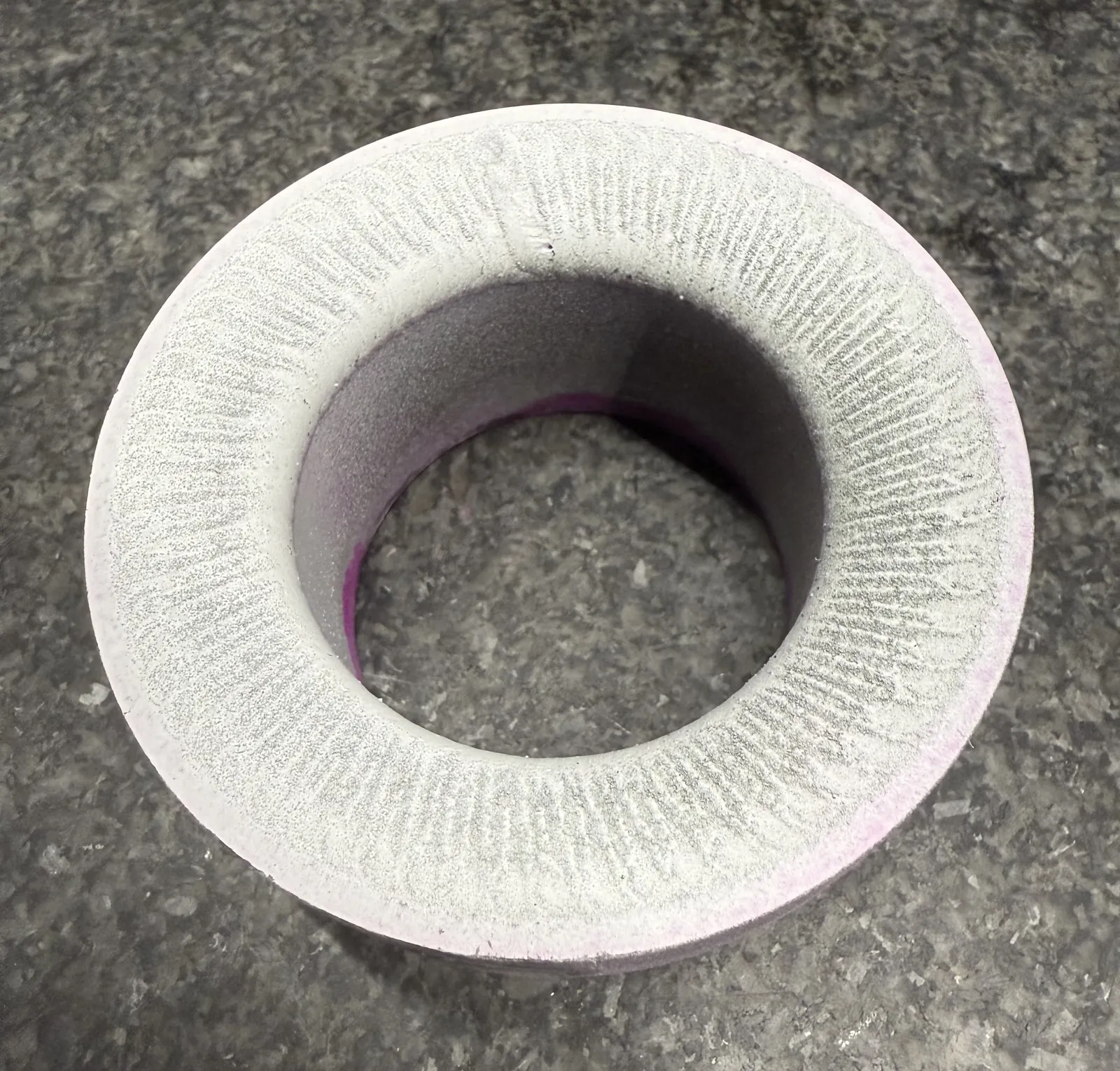
Wear-resistant coatings can be useful for sliding and tribology applications, but they can also be sensitive to crack risk. A valve seat ring or wear ring can look like a simple circular coating job, yet the geometry, heat route and layer strategy can decide whether the result is usable.
The short answer
For hard LMD / laser cladding coatings on ring geometries, the useful engineering question is not only which powder is used. The route has to control thermal stress, powder delivery, travel-speed behavior, layer count, closing points, finishing allowance and inspection. Dye penetrant testing is a practical way to make crack and pore risk visible after deposition.
What the anonymous ring study showed
An Exafuse project evaluated a wear-resistant coating material on two geometries: a valve seat ring and a wear ring. The exact project material is not publicly disclosed. The valve seat ring had an approximate outer diameter of 86 mm, inner diameter of 55 mm and coating width of 11 mm, with a target coating around 2.5-3 mm. The wear ring had an approximate outer diameter of 55 mm, inner diameter of 33 mm and coating width of 8.5 mm, with a target coating around 1.5 mm.
Why preheating was not enough by itself
The project reports evaluated laser power, powder feed, travel speed, spot size, preheating and layer count. Exact settings are controlled project data, but the practical lesson can be shared: preheating helped manage thermal stress, yet it did not solve crack risk alone. Powder-feed direction, travel speed, layer strategy and the way a path closes also mattered.
What dye inspection adds
Dye inspection gave the project a direct visual check for surface-breaking cracks and pores in the photographed condition. That does not replace every possible inspection route, but it is a useful inspection step for hard cladding projects where crack risk is part of the technical question.
How to use this lesson in an RFQ
Send ring photos, drawing or CAD, outer and inner diameter, coating width, target layer height, base material, wear mode, required final surface and inspection expectations. Any requested coating material still needs to be reviewed against geometry, heat input, finishing and acceptance criteria.
What not to assume
A successful ring coating route is not a universal parameter recipe. It shows that hard cladding can be developed through controlled process studies, geometry-specific planning and inspection-backed review. Similar parts still need their own feasibility check.