
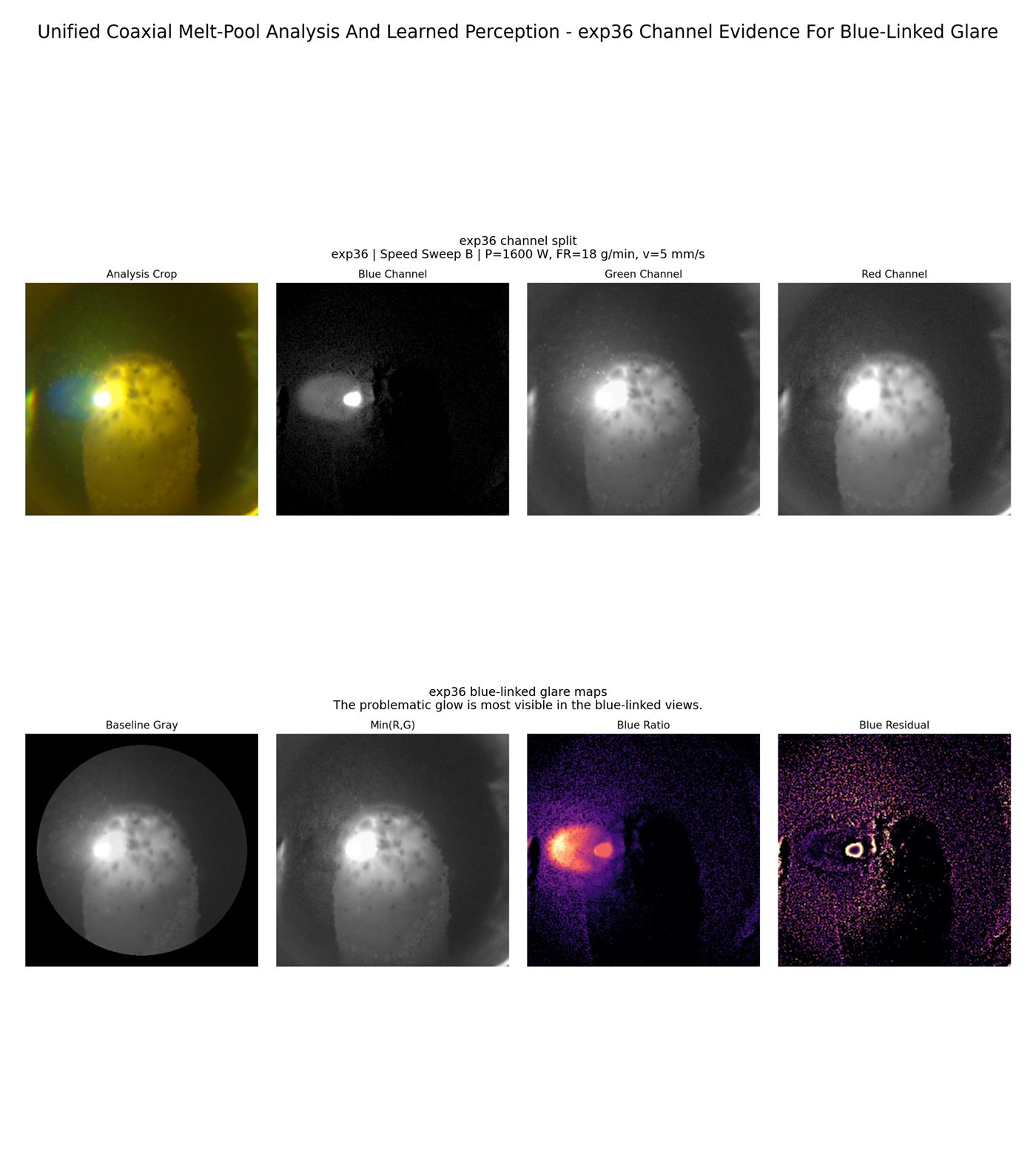
Computer vision for melt-pool monitoring is useful when it helps engineers review process behavior faster and more consistently. It becomes risky when a model is treated as proof of part quality without checking drift, failure modes and inspection evidence.
The short answer
Computer vision can support LMD monitoring by screening melt-pool images, plume behavior, track continuity or other visual process signals. The hard part is not training a model once. The hard part is keeping the model reliable when geometry, optics, powder behavior, exposure settings or materials change.
Where computer vision fits
The best use case is decision support. A model can help sort long image sequences, highlight unusual zones, compare tracks or direct an engineer toward the right inspection question. That is stronger and more credible than claiming automatic defect-proof production.
Why dataset drift matters
Dataset drift appears when the current production reality no longer matches the data used to develop the model. In LMD this can happen through:
- new part geometries;
- changed camera angle or optics;
- different alloys or substrate conditions;
- powder-feed variation;
- lighting, plume or exposure changes;
- layer-history effects in longer builds.
If these shifts are not tracked, a model that looked stable in development can become unreliable on the shop floor.
False positives and false negatives
False positives waste engineering time because they flag normal process behavior as a problem. False negatives are worse because they miss a condition that should have triggered review. For industrial users, both error modes must be discussed openly before any monitoring output is treated as a release-relevant signal.
Why image confidence is not part confidence
An image model can classify patterns in the melt pool. It does not automatically prove bonding, porosity, dimensional conformity or acceptable microstructure in the finished part. That connection must be built through validation, not assumed from model confidence.
What buyers should ask
Ask what image source is used, how drift is monitored, how false alarms are handled, how missed events are checked, and which inspection evidence is used to confirm whether the model output was meaningful.
Related pages
Use A35: Melt-pool monitoring, A36: AI in LMD process control, A41: LMD monitoring data pipeline and A42: validating AI outputs against inspection together when the project depends on monitoring credibility.