Mining equipment works in abrasive, impact-loaded environments. Even when the base component remains usable, the surface that carries relative movement can become the limiting factor for service life, fit and maintenance effort.
The short answer
Exafuse can use Laser Metal Deposition as a hardfacing route for wear-loaded mining-machine components. In this proof, LMD was used to build a wear-resistant layer on the curved working surface of a dozer blade holder so the surface function could be improved without remaking the full component.
Process video: LMD around a curved wear surface
The process video shows why this is more than a flat coating coupon. The deposition route has to follow a large circular surface, keep the process head accessible and place the layer consistently around the wear track.
Deposition detail
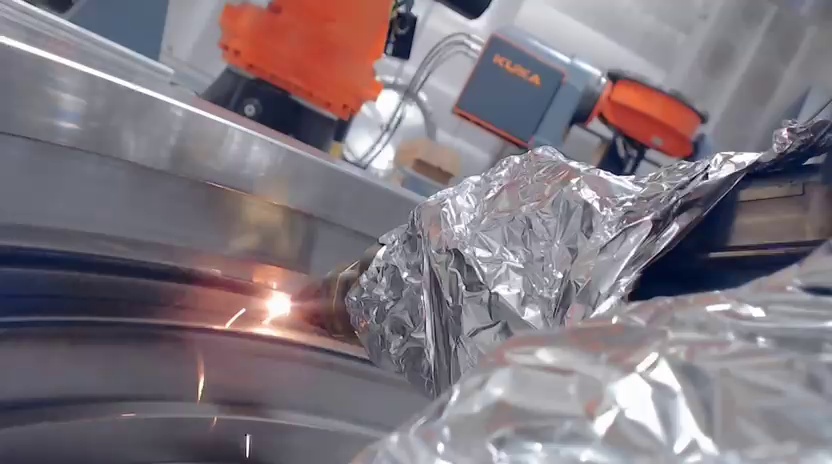
Hardfacing with LMD is not only about making a surface harder. The coating has to connect to the base part, build to a useful thickness range, remain suitable for later finishing and support the inspection route required by the application.
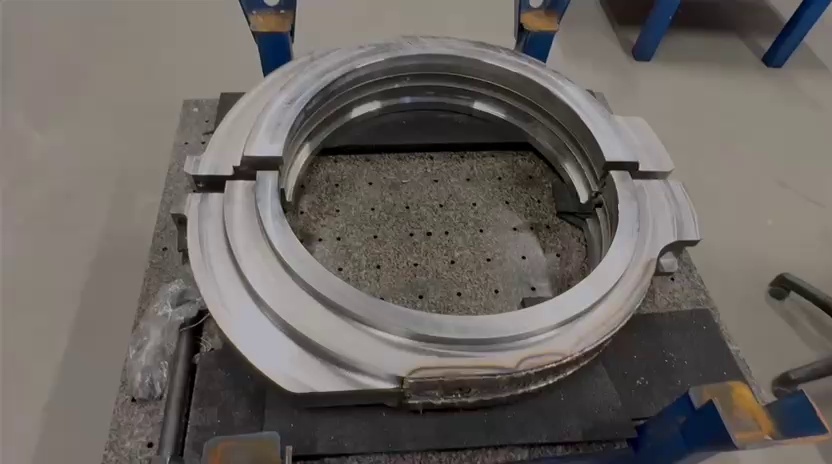
Finished coated holder
Why this part type is a good hardfacing candidate
The public source context describes a holder component working with relative movement against a mating ring. That kind of contact can combine sliding, pressure, contamination and abrasive wear. A targeted hardfacing layer can protect the surface where the damage happens while keeping the bulk part and its original geometry logic in place.
What Exafuse has to manage
- Surface preparation before deposition.
- Process access around a ring-shaped wear surface.
- Layer consistency on a curved track.
- Heat input, dilution and bond quality with the base part.
- Crack risk and coating behavior in a hardfacing system.
- Post-process finishing, hardness checks and inspection needs.
Decision table
| Decision point | What it means for mining-equipment hardfacing |
|---|---|
| Wear mechanism | Clarify whether abrasive wear, sliding contact, impact, contamination or a mixed mechanism dominates the surface problem. |
| Base component condition | The bulk part must still be worth protecting, restoring or upgrading; broad structural damage changes the decision. |
| Coating target | Define the target area, approximate build range, finishing allowance and contact surface after machining or grinding. |
| Material route | The coating system, buffer logic and substrate compatibility need engineering review before field assumptions are made. |
| Validation boundary | Hardness checks, layer review and inspection support the decision, but field-service life and qualification stay application-specific. |
Readable summary: evaluate LMD hardfacing when a high-wear surface on a valuable mining component can be protected locally; escalate when the wear mechanism, base material, coating target, finishing route or acceptance criteria are unclear.
What this proves and what it does not prove
This proof shows that Exafuse can plan and execute LMD hardfacing on a real ring-shaped mining-machine holder surface and connect the media story to coating-route thinking. It does not publish or prove the exact material recipe, coating height, hardness result, service lifetime, field qualification, universal wear guarantee or production release for every mining component.
What to send for a similar review
- Photos of the worn or target surface.
- Drawing, CAD model or sketch of the coating area if available.
- Base material or best available material assumption.
- Expected wear mechanism and mating material.
- Lubrication, contamination, corrosion or temperature context.
- Target coating area, approximate thickness range and finishing allowance.
- Whether the part will be machined, ground or inspected after coating.
- Acceptance criteria, documentation needs and timing pressure.
Recommended next steps
Use the laser cladding service page, repair and modification service page, failure-mode map, corrosion and high-temperature coating guide, documentation guide, the material selector and the cladding review route when planning hardfacing for a mining wear component.