
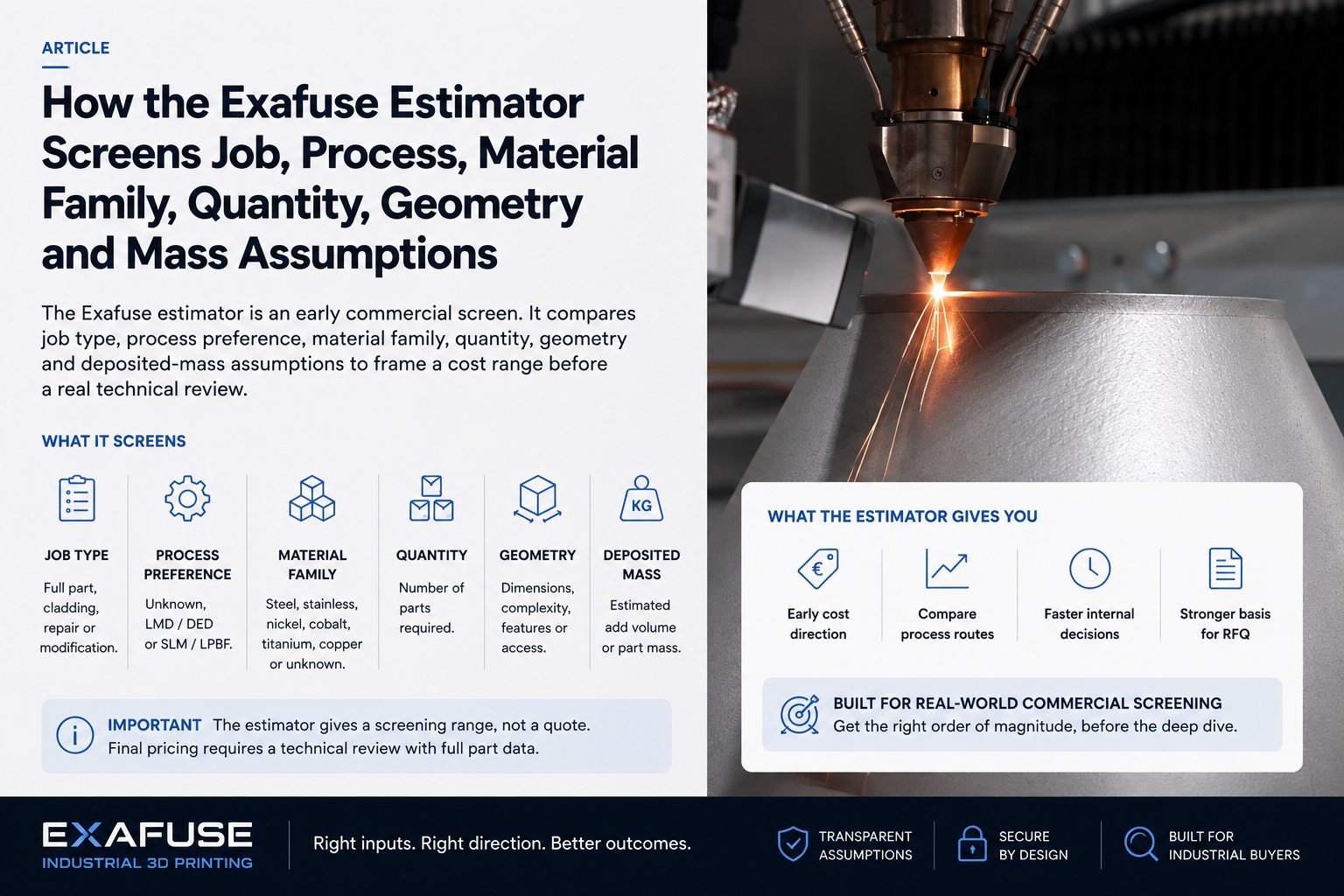
Industrial cost discussions go wrong when a rough estimate is treated as a quotation. The Exafuse estimator is deliberately narrower than a project-specific offer.
The short answer
The estimator turns early project assumptions into an indicative range. It considers the job type, likely process, material family, quantity and the geometry or deposition mass entered by the user.
What the estimator checks
- Job type: full part, cladding, repair or modification.
- Process preference: unknown, LMD / DED or SLM / LPBF.
- Material family: steel, stainless, nickel, cobalt, titanium, copper or unknown.
- Quantity.
- Geometry or deposited-mass assumptions depending on the job.
- Coarse LMD mode where relevant.
Why deposited mass matters
Buyers often begin with the overall dimensions even when only a local area receives new material. This is especially relevant for repair and laser cladding. The estimator therefore distinguishes a complete build from local material addition.
What the result means
The output is an indicative range, not a quotation. It helps a team decide whether to compare repair and replacement, prepare an RFQ or request technical review.
How the range is kept conservative
The estimator rejects impossible negative inputs, keeps quantity positive, checks SLM against the 400 mm round-platform context and returns a range instead of a false-precision number. The mass shown is net deposited or build mass, not powder consumption, catchment efficiency or final quoted material usage.
What the estimator does not include
It does not fully price fixturing, engineering time, post-processing risk, complex inspection, confidential material sourcing or geometry-specific programming. Those items require a project review.
Assumptions to verify
The result depends directly on the selected process, material family, quantity and mass. Incorrect assumptions can move the range substantially and should be replaced with measured or drawing-based data before an offer is requested.
Next step
Use the cost estimator, then continue with the repair cost comparison, RFQ builder, repair-economics guide or RFQ checklist.