
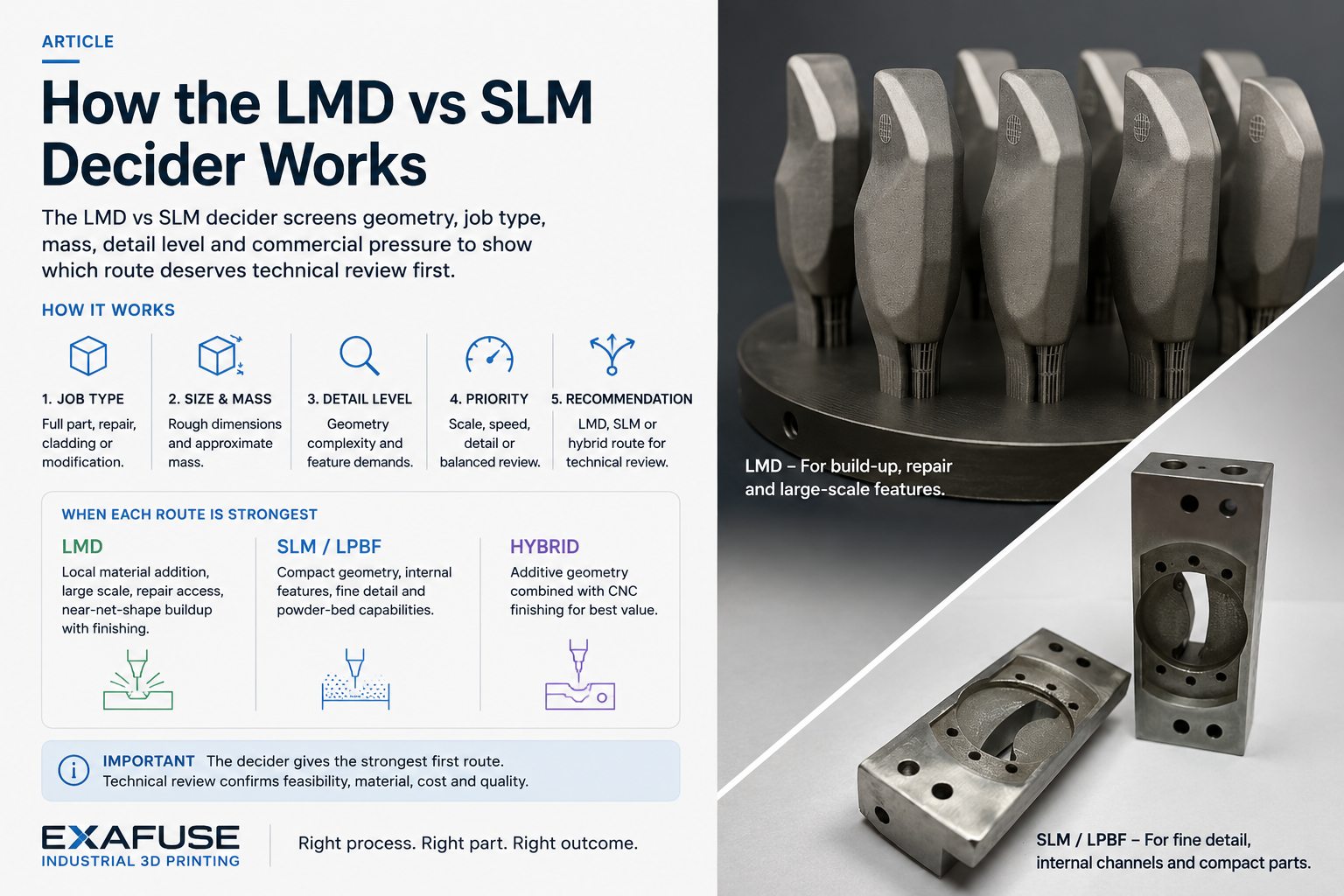
Industrial process selection often fails because the team compares process names instead of what the part actually needs. The Exafuse decider keeps the first assessment practical.
The short answer
The decider checks whether the job is a new build, repair, cladding or modification, then considers dimensions, approximate mass, detail level and commercial pressure. The output is not a final answer; it is a sensible starting point for technical review.
Inputs the decider uses
- Job type: full part, repair, cladding or modification.
- Rough dimensions and approximate part or buildup mass.
- Detail level: standard geometry, fine features, internal channels or large simple buildup.
- Commercial pressure: scale, speed, detail or balanced review.
How the comparison works
LMD is usually the stronger candidate when local material addition, large scale, repair access or near-net-shape buildup followed by machining creates the value. SLM / LPBF is usually stronger for compact parts with internal features and fine integrated detail. A combined additive and subtractive process can be appropriate when deposition and final machining both contribute to the result.
Platform and geometry check
The decider uses the approved Exafuse SLM context as an initial check, not a final machine reservation: a 400 mm round platform and 400 mm build height. A rectangular 400 x 400 mm envelope is not treated as a safe SLM fit, because the XY diagonal exceeds a 400 mm round platform. If length, width or height are missing or zero, the tool asks for better geometry instead of pretending to know the answer.
What the decider cannot know alone
It cannot fully assess material compatibility, substrate condition, powder availability, distortion risk, finishing cost or inspection scope. Those questions still belong in technical review.
Why the first process choice matters
A weak process choice wastes time twice: first in quoting, then in engineering. A good initial assessment does not replace feasibility review, but it can prevent teams from starting in the wrong place.
Related examples
Compare the large repair-component example with the compact internal-channel example to see how the same criteria can lead to different process choices.
Next step
Use the LMD or SLM decider, then consult the LMD vs SLM guide, hybrid manufacturing guide or Metal AM service for the process that appears most suitable.