
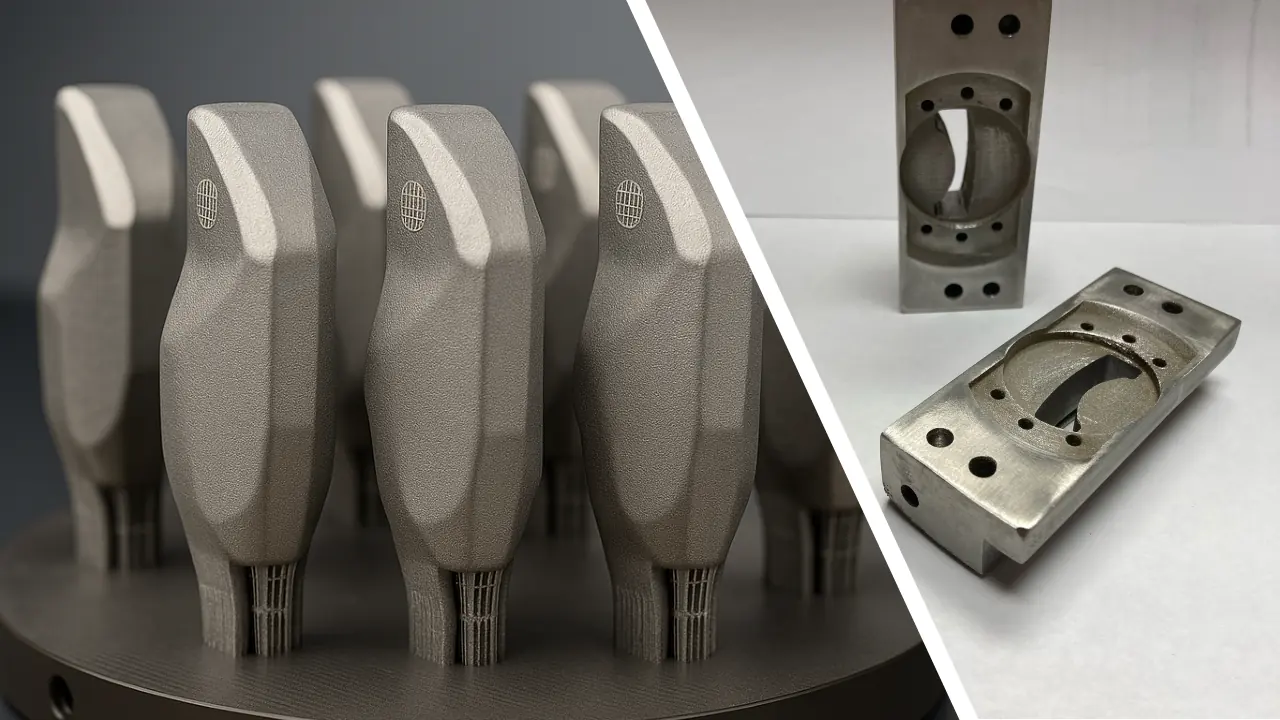
The essential difference
LMD uses a laser and a supplied metal feedstock to deposit material onto a substrate or previously deposited layers. SLM/LPBF selectively melts regions of a metal powder bed, one layer at a time. Both produce metal components, but they address different design and manufacturing needs.
LMD is particularly strong for large geometry, local material addition, repair, modification and laser cladding. SLM/LPBF is strongest where compact parts depend on fine detail, internal channels, lattices or other powder-bed-native features.
When LMD is the stronger starting point
- An existing component needs local repair, modification or coating.
- The geometry is too large for the available powder-bed system or is suited to near-net-shape deposition.
- Only selected regions require additional or higher-value material.
- Deposition, machining and inspection can be planned as one process chain.
Laser and powder access, heat input, fixturing, machining allowance and inspectability must be resolved early. Large dimensions alone do not make a component a good LMD candidate.
When SLM/LPBF is usually the better fit
- The part is compact and its function depends on fine integrated detail.
- Internal channels, lattices or powder-bed-native cavities create the main value.
- A complete new part must be built without an existing substrate.
- The available build volume, material and quantity suit the LPBF system.
SLM/LPBF may still require supports, heat treatment, removal from the build plate, machining and inspection. A useful comparison therefore covers the complete process chain to an acceptable finished part, not only the additive step.
Define a hybrid process precisely
The word hybrid should identify the actual combination. It may mean LMD followed by CNC machining, or a process chain that joins an SLM/LPBF component to a larger LMD buildup. The preferred combination is the one that meets geometry, material, tolerance, surface and inspection requirements with the clearest technical case.
Five questions for process selection
- Is the job a new part, repair, modification or coating?
- Which dimensions, mass and detailed features determine function?
- Which substrate and deposited material are required?
- Which surfaces need post-processing?
- How will dimensions, surface condition, bonding and any internal features be inspected?
Information needed for a defensible comparison
Send CAD or drawings, dimensions, material, quantity, critical features, functional surfaces, tolerances, target finish and inspection requirements. With those inputs, the process choice can be assessed technically and commercially. The LMD/SLM decider provides an initial direction; final feasibility remains component-specific.