
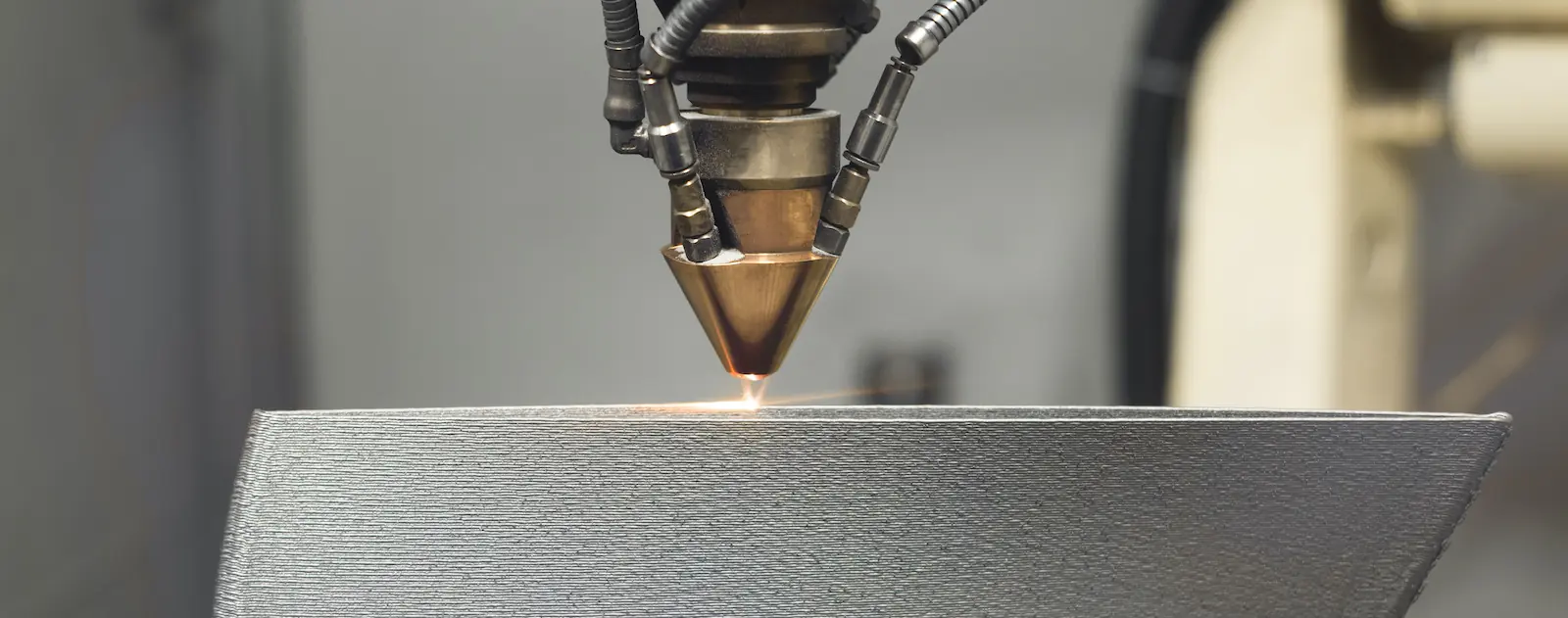
Laser Metal Deposition, DED, DED-LB/M, laser cladding, laser deposition welding, Laserauftragschweissen and direct metal deposition are used differently across industry, but buyers usually need the same practical answer: when is this route technically worth evaluating, what should be checked first, and what evidence should be requested before release?
The short answer
Laser Metal Deposition is the broad industrial route for local material build-up, repair, cladding, large metal AM work and selected hybrid manufacturing decisions. ISO/ASTM 52900 defines directed energy deposition as an additive manufacturing process where focused thermal energy fuses material while it is being deposited. In practice, buyers search with many names, so the useful task is to connect the terminology to the real engineering decision.
Core questions
This guide brings together five recurring LMD / DED questions:
- definitions and process comparisons;
- industrial repair decisions;
- materials and alloy-family selection;
- quality, validation and inspection;
- AI-assisted monitoring and process-data interpretation.
Definitions and comparisons
Start here when the question is mainly about terminology, route fit or process boundaries.
- What Is Laser Metal Deposition?
- LMD vs SLM / LPBF
- Laser cladding for wear protection
- Hybrid manufacturing with LMD and CNC
Use these pages when the project team needs to distinguish LMD from DED, laser cladding, welding, powder-bed AM or a hybrid route.
Industrial repair
Use these pages when the part is worn, damaged, undersized, mis-machined or under replacement pressure.
- Repair vs replace framework
- Repair ROI model
- RFQ guide for repair and cladding
- Forging hammer repair with LMD
- Forging hammer repair case
- Gear and pinion repair guide
- Hydraulic rods, shafts and sliding surfaces
- Machining-error salvage
Materials
Use these pages when the central question concerns substrate, alloy family, wear mode or service environment.
- Alloy selection for laser cladding
- Corrosion and high-temperature protection
- Failure modes to cladding solutions
- LMD coatings on copper substrates
- Multi-material nickel-alloy LMD nozzle proof
Quality and validation
Use these pages when the project depends on porosity control, bonding quality, inspection scope or documented release logic.
- Porosity in LMD / DED
- Bonding, dilution, microstructure and HAZ
- CT, UT, PT/MT and CMM for repairs
- Monitoring and control in DED / LMD
- Qualification and documentation
- Melt-pool monitoring
AI in LMD
These pages cover Manish Sharma's public work on AI, machine learning, image processing and process-data interpretation in industrial Laser Metal Deposition.
- AI in LMD process control
- Pix2Pix-style image processing in LMD
- Computer vision, dataset drift and false alarms
- LMD monitoring data pipeline
- Validating AI outputs against physical inspection
- Public authority page for Manish Sharma in the Exafuse People section.
When not to use LMD
Do not force Laser Metal Deposition into every job. It can be the wrong route when the part is low value, the geometry needs full powder-bed detail, the damaged zone is not accessible, the substrate is unknown, the required finish cannot be reached after deposition, or the inspection and release route has not been defined.
What to send for a serious first review
Send the part goal, CAD or drawings if available, damage photos where relevant, base material, dimensions, target surface or rebuilt zone, finishing needs, inspection expectations and deadline pressure. If AI or monitoring evidence matters, define that at the RFQ stage rather than after production.
Recommended next steps
Start with the knowledge hub for the full library, the LMD vs SLM decider for route screening, the material selector for failure-mode-driven material direction, or the contact page when the route is already clear.