
When Laser Metal Deposition is suitable
Laser Metal Deposition, or LMD, adds metal to an existing substrate or to previously deposited layers. It is particularly useful when material is needed only in a defined area, when a large component must be built near net shape, or when a worn region needs repair or a functional coating.
SLM/LPBF is often a better choice for compact parts whose function depends on fine detail, internal channels or other powder-bed-native geometry. Conventional manufacture or replacement can also be preferable when it provides a simpler and more economical result.
LMD, DED-LB/M and laser cladding
Directed Energy Deposition is the wider process family. DED-LB/M identifies the laser-based metal variant, while Laser Metal Deposition is the common industrial name for the process. Laser cladding uses the same basic deposition principle, but the objective is a local surface function such as wear or corrosion protection rather than a complete new part.
The process can therefore serve four distinct jobs: build new geometry, modify an existing component, restore damaged material or apply a functional surface layer.
How an LMD track is formed
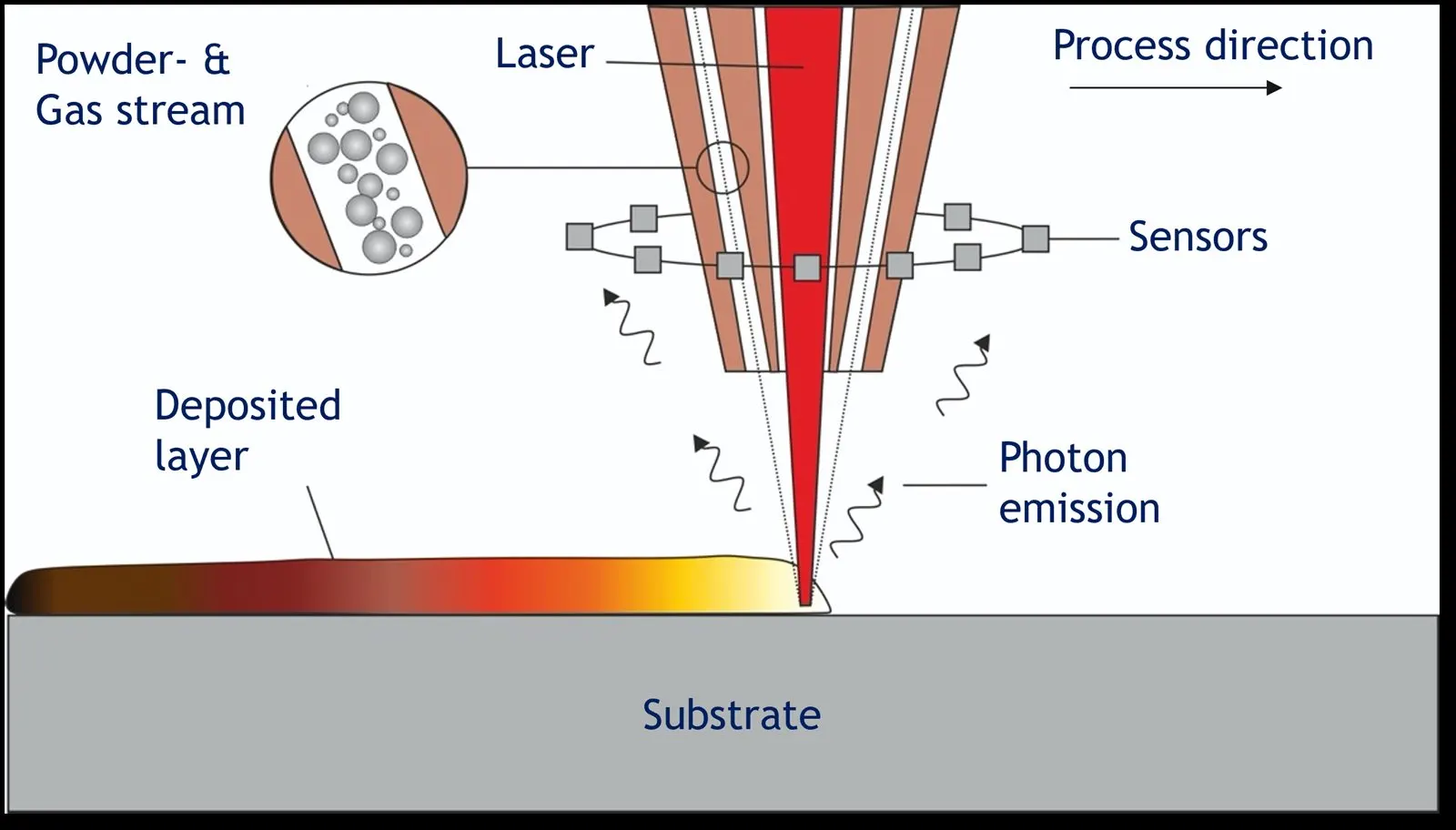
A focused laser creates a local melt pool. Metal powder enters that zone and forms a metallurgical bond with the substrate or previous layer. Adjacent tracks and successive layers create the planned geometry.
Track width, layer height and deposit quality do not depend on one setting. Laser power, spot size, travel speed, powder mass flow, overlap, shielding, heat input and part geometry interact. Parameters therefore have to be developed and checked for the material, machine and component task.
Plan material, finishing and inspection together
Material selection starts with the substrate and the required function of the deposited region. Repair and cladding work also requires attention to dilution, the heat-affected zone, crack sensitivity and machinability.
Industrial LMD parts commonly need post-processing. Milling, grinding or another finishing step may be required to produce functional surfaces, fits and defined surface conditions. Inspection should reflect part function and risk and may include dimensional checks, surface inspection, non-destructive testing, metallography or other project-specific methods.
Process limitations
LMD is not a replacement for every casting, forging, welding or machining process. Restricted access, difficult heat management, very fine full-part geometry, demanding detail or areas that cannot be inspected may rule it out. Process monitoring can help engineers interpret the build, but it does not replace physical inspection or agreed acceptance criteria.
Information needed for an initial feasibility review
Useful inputs include CAD data or drawings, dimensions, substrate material, target geometry or damage zone, functional surfaces, machining allowance, quantity, schedule and inspection or documentation requirements. These details allow LMD to be compared properly with SLM/LPBF, an additive-subtractive process chain or conventional manufacture.